
From Third World To First by Lee Kuan Yew
The Singapore Story: 1965 - 2000

Background
I tend to read in themes. A few years back, I went through all of the famous American industrialists — Vanderbilt to Rockefeller to Carnegie. This year, I got into politicians. The LBJ books talked about China which led me to Deng Xiaoping. Deng Xiaoping spoke a lot of his trips to visit Lee Kuan Yew in Singapore so naturally I picked up Lee’s book From Third World to First.
From Third World to First covers Singapore from its independence from Malaysia in 1965 through the year 2000.
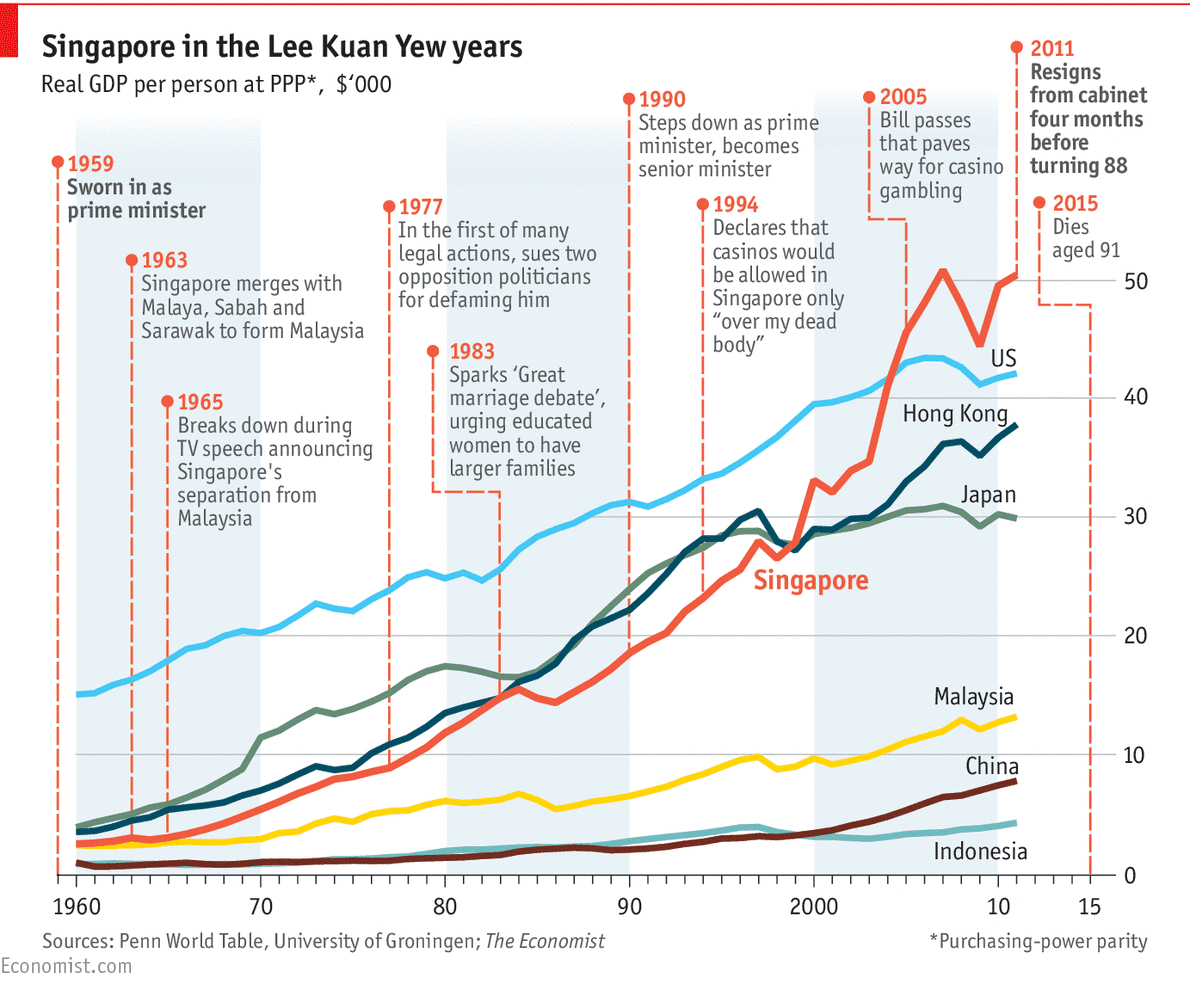
Lee was Singapore’s Prime Minister from 1959 (when it separated from Britain) through 1990 and he writes in detail about the challenges and decisions Singapore made on its path to becoming one of the world’s wealthiest and most productive cities.
The book is ~650 pages long and broken into two distinct sections:
Part 1: How did Lee and his peers transform Singapore from a fragile colony into a global leader. Today’s post will focus mostly on this section of the book.
Part 2: Lee’s interactions with foreign leaders. This section gives incredible insights to most Southeast Asian and East Asian countries, though it can be a bit burdensome at times.
Lee is a fun author to read, who communicates directly and authentically. To give you an idea of his style, here is an excerpt about socialism:
Watching the ever-increasing costs of the welfare state in Britain and Sweden, we decided to avoid this debilitating system. We noted by the 1970s that when governments undertook primary responsibility for the basic duties of the head of a family, the drive in people weakened. Welfare undermines self-reliance. People did not have to work for their families’ well-being. The handout became a way of life. The downward spiral was relentless as motivation and productivity went down. … It was difficult to counter the seductiveness of welfare promises by the opposition during elections. In the 1960s and 1970s, the failure of the European welfare state was not yet self-evident. It took two generations for the harm to work its way through and be seen in lowered performance of individuals, sluggish growth rates, and growing budget deficits.
Since the book covers so many topics, today’s post will too. Instead of doing a few deep dives, I will cover six themes at a high-level.
I hope you enjoy!
Desperation
I’ve always been impressed by what certain smaller countries can do. Think about places like Singapore, Israel, and Taiwan. Each punch way above their weight in the world order.
A big component of their success is that they simply had to succeed or they would not exist.
After pondering these problems and the limited options available, I concluded an island city-state in Southeast Asia could not be ordinary if it was to survive. We had to make extraordinary efforts to become a tightly knit, rugged, and adaptable people who could do things better and cheaper than our neighbors, because they wanted to bypass us and render obsolete our role as the entrepot and middleman for the trade of the region. We had to be different.
When Singapore first became a country, they had to deal with:
Its much larger countries next door — Malaysia and Indonesia — who wanted to replace Singapore as the main trading hub of Southeast Asia (and at times wanted to simply take over Singapore, period).
The spread of communism threatening to destabilize Singapore’s brand new government.
Britain withdrawing all of its troops only six years into their existence which left them both isolated from a security standpoint and removed about 20% of Singapore’s economy.
Lee had to figure out how to build an army, build government institutions, fill a 20% gap in the economy and unite his extremely diverse country. (Singapore was ~75% Chinese but also had large populations of Malays and Indians who all spoke different languages and had different religions.)
Notice how much this sounds like a startup — Singapore was much smaller than its peers, had vastly fewer resources, and was more of a ragtag group than a formal country.
While this was an extremely difficult period for Singapore (and Lee describes MANY of its challenges in the book), it provided the foundation for their stunning growth.
Just like in the startup world, desperation breeds creativity. And being a large incumbent who is not forced to innovate breeds complacency.
As Singapore has gotten wealthier and more powerful, Lee has started worrying about his country losing its edge.
I wrote this book for a younger generation of Singaporeans who took stability, growth, and prosperity for granted. I wanted them to know how difficult it was for a small country of 640 sq. km with no natural resources to survive in the midst of larger, newly independent nations all pursuing nationalistic policies. … We cannot afford to forget that public order, personal security, economic and social progress, and prosperity are not the natural order of things, that they depend on ceaseless effort and attention from an honest and effective government that the people must elect.
I think Singapore will always keep some of its edge — it is, after all, still a small country with no natural resources surrounded by much larger countries — but Lee is absolutely right.
We should all think about how we can remain scrappy and keep a sense of desperation that forces us to constantly iterate and move faster. The less complacent we can be, the better.
Wet snow
We talked about this concept in my post about Warren Buffet but the idea is that it’s much easier to build a snowball with wet snow than dry snow.
Lee took the same approach to building Singapore.
If Singapore could establish First World standards in public and personal security, health, education, telecommunications, transportation, and services, it would become a base camp for entrepreneurs, engineers, managers, and other professionals who had business to do in the region.
Notice how this is almost the opposite approach that mainland China took in the 1980s. China wanted to build everything themselves — their own human capital, their own businesses, use their own money, etc.
However, China’s strategy of building everything would take decades. China had decades because of its size and robust government apparatus.
Singapore did not.
They needed to turbocharge their growth and Lee used Hong Kong as a successful example:
I did not understand then that when the communists “liberated” the mainland in 1949, with the influx [to Hong Kong] of some 1 to 2 million refugees from China had come some of the best entrepreneurs, professionals, and intellectuals from Shanghai and the provinces of Shejiang, Jiangsu, and Guangdong. They formed a thick layer of talent that was to transform Hong Kong into one of the most dynamic cities in the world, helped by the more enterprising and resourceful of the Chinese workers who had decided to leave China rather than live under communist rule.
While Hong Kong got “lucky” that Mao caused millions of entrepreneurs to relocate, Singapore needed to manufacture its own luck.
The main source of Lee’s success was in forming partnerships with large multinational corporations (MNCs). There are some amazing stories in the book about various stunts they did to attract MNCs but the point is that Lee didn’t go to America begging for foreign aid or handouts. He went offering to help them make money.
Visiting CEOs used to call on me before they made their investment decisions. I thought the best way to convince them was to ensure that the roads from the airport to their hotel and to my office were near and spruce, lined with shrubs and trees. When they drove into the Istana domain, they would see right in the heart of the city a green oasis, 90 acres of immaculate rolling lawns and woodland, and nestling between them a nine-hole golf course. Without a word being said, they would know that Singaporeans were competent, disciplined, and reliable, a people who would learn the skills they required soon enough.
Notice the adjectives he chose — competent, disciplined and reliable. These three traits were mentioned over and over in the book and gave MNCs confidence in Singapore.
This was what made foreign investors site their factories and refineries here. Within days of the oil crisis in October 1973, I decided to give a clear signal to the oil companies that we did not claim any special privilege over the stocks of oil they held in their Singapore refineries. If we blocked export from those stocks, we would have enough oil for our own consumption for two years, but we would have shown ourselves to be completely undependable.
Other former British colonies like Nigeria were nationalizing the local operations of MNCs while Singapore went out of its way to protect them.
Over the decades, Singapore became the trusted place to put your factories, to store your oil and to hold your money. This trust did not solely come from Lee and Lee himself cites the importance of having strong institutions.
The foundations for our financial center were the rule of law, an independent judiciary, and a stable, competent, and honest government that pursued sound macroeconomic policies, with budget surpluses almost every year.
While running your company, think about how you attract the best talent to come and work for you. Think about how you can treat your customers and investors like Singapore did its MNCs and foreign investors.
These choices — especially when in a time of crisis — will pay dividends over the long run.
Aligned incentives
Even though Singapore is quite capitalistic, it has strong socialist tendencies. While part of this comes from its history with Britain, it mainly comes from the fact that 75% of Singaporeans are ethnically Chinese.
Chinese culture is way less individualistic than Western culture and you are taught from a young age to sacrifice some of your personal ambition for the well being of the group.
On top of this, Singapore has mandatory military service.
National service has had a profound impact on Singapore society over the last 30 years. It has become a rite of passage for our young men and a part of our way of life that has helped to unify our people. They learn to live and work closely with each other, regardless of race, language, or religion. Food taboos of Muslims and Hindus are respected, as are all religious rites, from Buddhist, Hindu, Muslim, Sikh to Christian and Zoroastrian.
Lastly, Singapore went out of its way to make sure home ownership was high.
My other important motive was to give all parents whose sons would have to do national service a stake in the Singapore their sons had to defend. If the soldier’s family did not own their home, he would soon conclude he would be fighting to protect the properties of the wealthy.
While this section might seem a bit eclectic — what do Chinese culture, mandatory military service and home ownership have to do with each other? — it shows that Lee actively sought to unify his country through a sense of group identity.
He wanted everyone to have a vested interest in the long-term success of Singapore.
In other words: Lee gave all of his “employees” equity in “Singapore Inc.”
He did this for the same reason startups give equity to employees:
People will make better long-term decisions, as opposed to trying to achieve short-term goals
People will work harder and will be less likely to quit
When you are resource constrained, it allows you to attract top-tier talent who you wouldn’t otherwise be able to compensate in cash
Privatization vs competition
Initially China and Vietnam downplayed Singapore’s success. These two countries were vying to create communist societies and any success of a capitalist country had to be attacked.
Eventually though, the failures of communism and the success of Singapore became undeniable. So much so that China and Vietnam started coming to Lee for advice.
Vietnam in particular wanted Lee’s help and asked him about their plan to start privatizing businesses again. At a high-level, Vietnam wanted to privatize businesses but restrict any foreign MNCs from entering the country.
Lee told them their plan was destined to fail and used Singapore Airlines as an example:
Singapore Airlines was 100 percent government-owned, but it was efficient and profitable because it had to compete against international airlines. We did not subsidize it; if it was not profitable, it would have to close down. I recommended that [Vietnam] privatize their [State Owned Enterprises] by bringing in foreign corporations to get an injection of management expertise and foreign capital for new technology. A change in the management system was essential. They needed to work with foreigners to learn on the job. Privatizing within the country by selling to their own people could not bring about this result.
While private ownership and free-market-competition normally go hand-in-hand, Lee argues that a government owned business in a highly competitive market1 would perform better than a privately owned business with no competition.2
I had never really thought about this distinction before but I think it’s right and that we should focus more on increasing competition than we should on particular ownership structures.
Culture
Lee is a colorful writer who isn’t afraid to speak his mind. However, he isn’t always the most politically correct. While some of these descriptions might stereotype a bit much, there are some useful lessons from them.
Take Lee’s description of Japanese people.
Pride in their job and the desire to excel in their given roles, whether as cook, waiter, or chambermaid, makes for high productivity, and in manufacturing, near-zero defect products. No nation in Asia can match them, not the Chinese, Koreans, Vietnamese, or Southeast Asians. They consider themselves a special people. You are either born a Japanese and therefore in that magic circle, or you are not. This myth of being special makes them a formidable force as a nation, a corporation, or a team in any workplace.
Or his description of Hongkongers.
A Hong Kong entrepreneur who settled in Singapore summed it up for me succinctly. When he established textile and garment factories in Singapore in the early 1970s, he brought his Hong Kong managers with him and hired several more Singaporeans. The Singaporean managers were still working for him in 1994, while his Hong Kong managers had set up their own businesses and were competing with him. They saw no reason why they should be working for him when they knew the trade as well as he did.
Or his descriptions of the British.
When I was in Japan in 1967, I visited the Yokohama shipyards of shipbuilders IHI … The vice president, Dr. Shinto, was a stout, energetic, able man and an outstanding engineer. … He wore rubber boots and a hard hat and provided me with the same before we toured the dockyard. He knew every inch of it and gave a running commentary in English … he explained the difference between British and Japanese managements. Japanese executives and engineers start work on the factory floor. They had to understand the low-level workers before they could rise from the ranks to lead them effectively. … Later that year, I visited Swan Hunter’s shipyards on the Tyneside [in Britain]. Sir John Hunter took me through his dockyard. The contrast was stark. Sir John wore a beautifully tailored suit with highly polished shoes. We drove up together in a Rolls Royce. …. We were driven off, not to an office working lunch but to the Gosforth Hotel, where we had an excellent meal before playing 18 holes of golf. The British executive lived in style.
The lesson here is two-fold:
Cultures are powerful. Part of the reason Japan was able to rebuild itself from the ashes of WWII was because they believed they were a special people. Special people can achieve special things. Or as Steve Jobs / Apple said, “the people who are crazy enough to think they can change the world, are the ones who do.”
Cultures are limiting. People talk about product-market-fit but perhaps we should talk about product-culture-fit the same way. Singapore produced excellent managers but bad entrepreneurs. So it made sense for Lee to attract existing MNCs to his country instead of trying to create brand new companies from scratch. Japan had extremely proud people who sought perfection, something perfect for creating zero-defect manufacturing facilities.
With these in mind, what is your company culture? Does it fit your product? What are you actively doing to shape your culture to make it fit better? If you like your culture, what are you doing to strengthen / reinforce it?
Building vs maintenance
This section will be the shortest but I loved this quote.
I recounted how I had visited almost 50 countries and stayed in nearly as many official guesthouses. What impressed me was not the size of the buildings but the standard of their maintenance. I knew when a country and its administrators were demoralized from the way the buildings had been neglected — washbasins cracked, taps leaking, water closets not functioning properly, a general dilapidation, and, inevitably, unkempt gardens.
While building things is a huge achievement that we should celebrate, it can often be more difficult to maintain them.
Think about Instagram. Yes — the app itself is very impressive and they have shipped many new features over the years — but I imagine they spend way more time and money on maintenance.
Instagram needs to ensure the app is online every time you open it. They need to ensure your feed loads quickly every single time. They need every like and every comment to work as intended, always.
If the app crashed 10% of the times you opened it or it took 2 minutes to load your feed, you and your friends would probably start looking for alternatives. Even if the initial features were amazing.
My question for you: how well maintained is your product / company?
TL;DR
Small countries can often look and act like startups
Try to find ways to remain scrappy and to keep your edge. It will force you to continue to innovate and delay complacency
A huge part of Singapore’s success was in making it an attractive place to entrepreneurs, foreign businesses, and foreign capital. Think about how you can make your company an attractive place to potential employees and investors
Singapore did a great job giving its citizens shared ownership in its success. Shared ownership does a great job aligning incentives for long-term prosperity
Privatization without competition does not work. The key to free-markets is competition
Cultures are extremely powerful tools (i.e. the Japanese are a “special people”) but make sure you have product-culture-fit (i.e. 20th century British culture was at a disadvantage for manufacturing)
Once you have built something, make sure you have a plan and resources to maintain it. Maintenance can sometimes be more difficult / more expensive than the building itself
Assuming, of course, that the business was not subsidized by the government.
A monopoly, basically.