
Price wars
Why it takes so long for incumbents to respond

Background
It’s fun to talk about how startups are great and run by really smart founders and that the large incumbents they are going up against are lazy and “past it” and have no idea what they are doing.
However, I had a professor in business school who always pushed back and said the people running these companies know what they are doing.
He then did an entire class about why large companies wait so long before responding to new startups.
The example he gave in class was about a local toothpaste company in the Philippines who was trying to push out Colgate from their local market. Colgate was much more expensive so the toothpaste company started stealing market share with lowered prices. He then showed why it made sense for Colgate to let this small brand take market share. It wasn’t because they were lazy, it was actually because they were smart.
While the toothpaste example and the example I give below deal with relatively undifferentiated, lower margin products, the lessons can be applied to almost any business.
And better yet, the example below shows why you don’t want to be in a business competing mostly on brand / price. You’d rather have network effects and be able to charge almost any price you want!
The incumbent
Let’s say you have a large widget company. They have been around for decades and have accumulated a dominant market position for widgets.
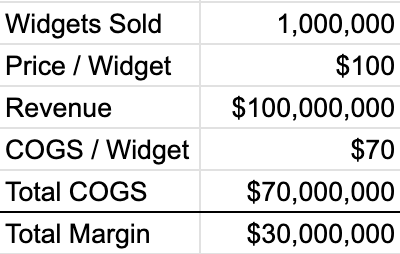
To put some numbers behind this, they currently sell one million widgets a year at $100 per widget.
The startup
Now you have an aggressive startup enter the market.
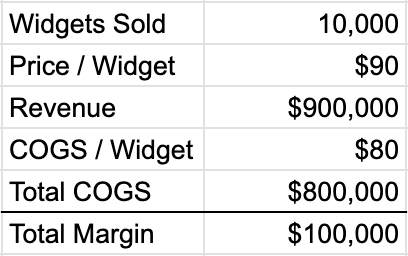
Since they don’t have the scale of the incumbent, it costs them more to make their widgets — let’s say $80 — but they are less focused on margins so they will try to undercut on price.
The incumbent’s response
Imagine you are the CEO of the incumbent.
What do you do? Do you drop your prices to $90 to match the startup? Do you drop them to $85 to establish dominance and scare off the startup? Do you drop them to $79 so that the startup would lose money if they matched your price?
It turns out the rational thing to do is….. nothing.
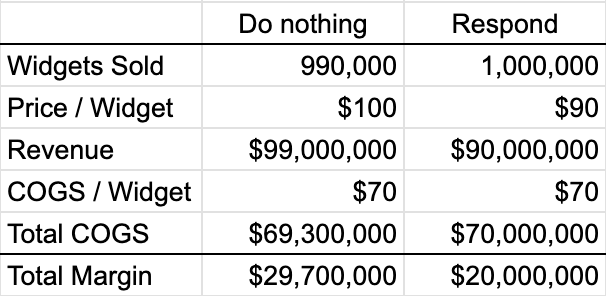
In the “do nothing” scenario, the startup sells out 100% of their inventory of 10,000 widgets because they are selling at $90 and we can assume all 10,000 of those widgets come directly at the incumbent’s expense.
Now the incumbent sells 990,000 widgets and have a profit of $29.7 million.
If they choose to respond by matching the $90 price, we can assume they sell all 1,000,000 of their widgets because the prices are the same and the customers prefer the incumbent’s known brand.
Even though they are selling more widgets, their profit has dropped down to $20 million if they respond. They are $9.7 million better of by….. doing nothing.
The startup’s response
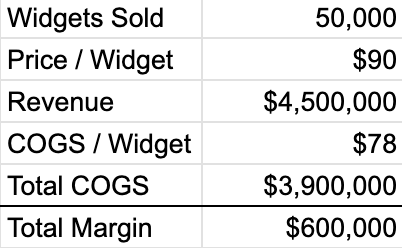
As the CEO of the startup, you see amazing demand for your widgets. You sold all 10,000 of them with positive unit economics so you double down and invest in growth.
Now you are selling 50,000 widgets at $90 and due to your new scale, COGS have dropped slightly to $78 per widget. Things are looking good!
The tipping point
Every few months, the incumbent is going have to decide if they should do something. Their sales keep going down, impacting revenue. And as they lose sales, their COGS per widget start to creep up since they no longer have as much scale.
Eventually, the startup gets big enough that it is finally rational for the incumbent to respond. In our example, it’s when the startup gets to ~25% market share.
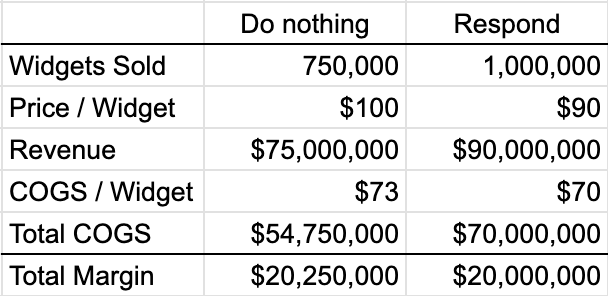
They are now indifferent between doing nothing and responding so will finally respond to stop the startup from getting any bigger.
The equilibrium
Once the incumbent drops prices to $90, the startup loses a lot of their sales. The incumbent still has the better known brand so most consumers choose the incumbent when the prices are the same.
The startup now has a choice of whether THEY should start another price war and to drop their prices to $85 to get more volume.
Now the startup is in a bind:
The startup has gotten large enough to where it’s economically rational for the incumbent to try and kick them out by lowering prices.
Since the incumbent still has more scale, their COGS will be lower meaning the incumbent can sustain lower prices than the startup. The startup will lose a prolonged price war.
The incumbent still has more brand power so the startup can’t have the same price, they have to have lower prices.
Knowing all of this, the startup decides to put on the brakes.
They stay at $90 and actually LOWER their production.
Instead of making 250,000 widgets, they cut back to 200,000 widgets.
Eventually, the incumbent sees the startup pulling back and the incumbent slowly raises their prices back to $100.
TL;DR
The reason incumbents often wait awhile to respond to new startups is that it is economically rational to do so
They’d rather lose a tiny amount of sales and keep their margins than get into a price war to keep sales up
There is, however, a point where they will respond. This point will depend on the margins of the industry you are in but typically it’s around 20-30% market share
If you are truly competing on price, the incumbent will almost always win. They will have scale advantages and brand advantages over the startup