
Division of labor
The division of labor is limited by the extent of the market.

Background
Today’s post was inspired by a recent episode of EconTalk. If you haven’t heard of EconTalk, it’s one of my favorite podcasts and I have been listening to it for close to a decade now.
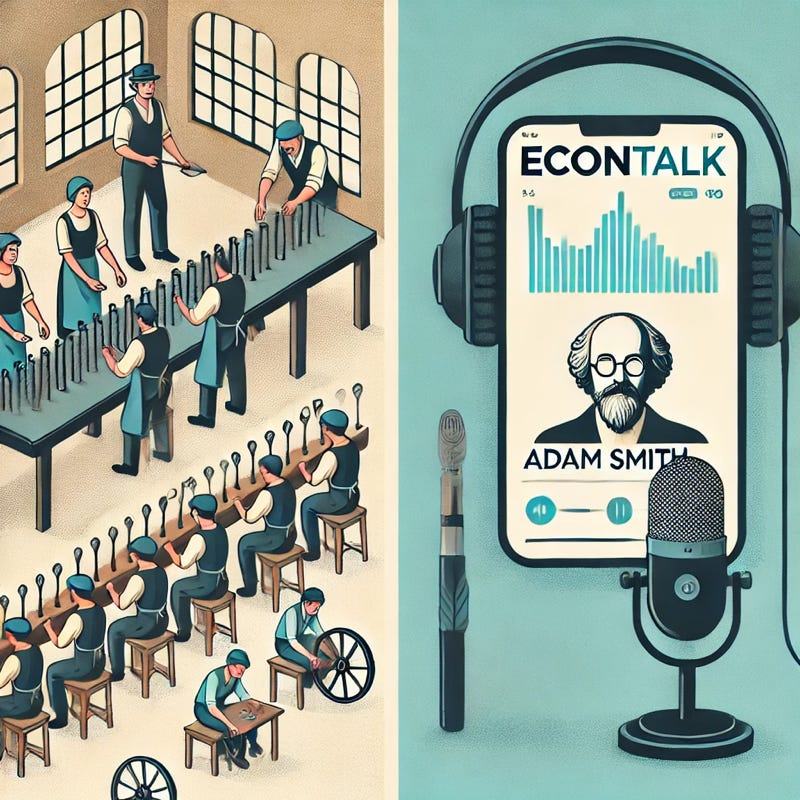
EconTalk is hosted by economist Russ Roberts, who recently had a great episode titled “What is Capitalism?” with Duke professor Michael Munger. The episode was interesting throughout but Munger spent a lot of time on the division of labor.
I don't think anyone, not one person in a hundred, understands division of labor. They can give you the definition but they don't understand it. And my evidence is: Duke students are smart and well-educated, and they have no idea what division of labor is.
So without further adieu, let’s talk about division of labor and why it’s so important.
Four people
I start with four people. … And let's suppose that these four people each want to have clothes, shoes, fish, and vegetables. And we start up: We all are in this little area and each of us are making our own clothes, our own shoes, catching our own fish, and growing our own vegetables. We are deeply, desperately poor.
I think a lot of you have probably heard of an example like this.
One person is good at fishing so they start to catch extra fish and to trade the extra fish with someone who is better at cobbling shoes. Through comparative advantage, we are all richer. And so on.
But in Munger’s example, everyone starts off exactly the same with no comparative advantage. Each person is exactly as good at each task as the others on day one.
However, as weeks go by, each individual acquires new skills. One tries to fish with a new technique that works a lot better.
I start at the margin. Because I'm a little bit better at fishing, I start spending more time at fishing and then exchanging for the other three things. You start making clothes and you start exchanging for the other three things. So, before long we end up, the four people have engaged in what's called artisanal specialization.
Notice:
Everyone started with the same skills but they developed new skills over time through practice. This is something Adam Smith calls dexterity.
No one told them to specialize. They just started doing it because they were better off doing so.
Now that I am the only one fishing, I am forced to catch four times as many fish as before. I am getting even better at it simply because I am doing it four times as much as before.
And since I am catching so many fish, it may make sense for me to start fashioning nets or building rudimentary fishing poles. These are both examples of creating tools.
Many of these tools would not have existed if I was only fishing for myself because 1) I would not have had time to create them and 2) even if I did have the time, it would not have made sense from a capital investment standpoint.
But enough about me. Let’s check back in on our four people now that each is specializing.
Before you had to make all four [items]. You spent 23 hours a day doing it. You could hardly ever sleep — otherwise you're going to be starving, have no shoes. You can barely provide. So, yes, you’re bored now for the 13 hours a day you work, but now you get a little bit of time off because you’re so much more productive. So, it was always boring if you had to work all the time. Now you have some leisure time.
So, the other thing that you start to engage in: because of improvements in dexterity, you have tool use. As you specialize, you start to think about technological improvements in the production process. And so, as a result, this little group of four people is much wealthier.
To summarize:
Specializing creates productivity gains through increased dexterity and tool making.
These productivity gains lead to real increases in living standards that then allow for more productivity gains.
Villages
So far we have been talking about four people. Now let’s say those four people live in an inland village with a river. The village next door to them is on the coast. Since they are on the coast, they are really good at fishing.
And so we say, 'You know what we could do? We seem to have really fertile land. Why don't all four of us engage in farming vegetables?' And, we will then be able to exchange the huge amount of vegetables we’re able to produce with this other village that now has started to produce only fish.
Since we now have four people who are solely focused on farming, we can subdivide the task of farming into four sub-components:
Seeds / Planting - Can start breeding better and better varieties
Plowing - Can start crafting plows out of sharp rocks and get into metallurgy
Storage - Can investigate the use of salt to keep the food fresh for longer
Transportation - Can start building wagons to get the food to the people who need it
While this might seem like a subtle change, this is actually a huge change.
We are finally shifting from having individual artisans — who did the entire task from start to finish — to having actual division of labor.
And the same mechanisms as before still apply:
Dexterity: Further specialization allows people to get better at each task since each task is now smaller and they are doing it more frequently
Tools: Increased scale allows them to invest in tools that would not be economical otherwise
Industrial revolution
This principle keeps on going as you expand:
The more trading partners, the larger the market you have.
The larger the market, the more specialization you can achieve.
The more specialization, the more productivity gains.
In other words:
Individuals trying to be entirely self-sufficient = working 23 hours a day to barely survive
Small villages engaging in artisanal specialization = working 13 hours a day but are still extremely poor
Villages trading with each other = working 10 hours a day and are getting by OK
But what happens if you build cities and then start connecting those cities?
Munger argues that you get the Industrial Revolution.
So, all of what we think of as the Industrial Revolution is driven by this tendency to truck, barter, and exchange, unleashed by market institutions that increase the extent of the market. No one says, 'You know, we need to have an Industrial Revolution.' It just happened. It was an emergent phenomenon that results from the fact that the division of labor is limited by the extent of the market, and the extent of the market wants to be bigger. We want to find more and more people to exchange with not because it makes them wealthier, but because it makes us wealthier. It just also makes them wealthier.
Once a market gets larger enough, it makes sense to build giant factories dedicated solely to producing steel. And then you can start using that steel to build railroads and ships which connect more people.
Which allows us to further specialize.
And so on.
Globalization
The end state is the globalized world we live in.
And to really hammer home the point, Roberts says:
[Y]ou pick the 99 most skilled people in the world to live with you on the most resource-rich island in the world.1 You can put any resources on that island that you want. You’re going to be desperately poor.
It doesn’t matter how skilled you are, because those hundred people, there’s not that much room for the division of labor.
But, when you trade with seven billion people … you could have unimaginable specialization. And the standard of living for people who have limited skill — not the hundred most-skilled people in the world: people who have okay-skill — can be fabulously well-off in the material sense from the opportunities to trade with this enormous group of people.
Let that sink in.
The fact that we live in a globalized world means people can dedicate their entire lives to solving specific types of cancer. To figuring out how to make smaller and smaller computer processors. To professional chess players. To being influencers.
I mean can you even think of the scale required for MrBeast to exist?
You have to create electricity. Then you have to create computers. Then you have to connect those computers. Then you have to be able to record video and send it to millions of computers. Quickly. Then advertisers willing to pay to be shown during those videos. Then you have to figure out a way to transfer money to MrBeast on these computers.
It requires so much specialized knowledge for this to work. A truly breathtaking amount of it.
And forget about creating the Internet.
There is a great article from 1958 called “I, Pencil” that argues there is not one single person on the planet who can make a pencil from start to finish:
Actually, millions of human beings have had a hand in my creation, no one of whom even knows more than a very few of the others. … There isn’t a single person in all these millions, including the president of the pencil company, who contributes more than a tiny, infinitesimal bit of know-how. From the standpoint of know-how the only difference between the miner of graphite in Ceylon and the logger in Oregon is in the type of know-how. Neither the miner nor the logger can be dispensed with, any more than can the chemist at the factory or the worker in the oil field.
With smaller markets, you simply can’t specialize enough because the division of labor is limited by the extent of the market.
Which brings me back to globalization.
I know globalization isn’t popular these days but it has single handedly brought billions of people out of poverty.
There’s this puzzle that for most of human history there wasn’t much improvement. There were some inventions in science; there’s some improvement; there’s changes in fashions. But then, at some point there was this giant takeoff, and as a result we have seen the decline of poverty at the same time that there was an enormous increase in the amount of population.
And, when you put those two things together, it actually does seem miraculous. It’s not just that a fixed number of people got relatively more wealthy. We doubled, tripled, quadrupled the number of people at the same time that the absolute level of poverty was also falling. And, the reason is division of labor. Division of labor is increasing returns.
De-globalization?
The world now seems to be going through a period of de-globalization and it’s important to understand that this has trade-offs.
Prices will go up, almost by definition.
Some products simply won’t be available.
Some brand new products / jobs / industries won’t be created.
I am not saying that globalization is perfect — nothing is — but an isolated world has its issues too.
This is something that Ayn Rand gets wrong with Galt’s Gulch, her imaginary Colorado town with only the most capable people living there.