
The Path to Power by Robert Caro
"Lyndon Johnson believed in nothing, nothing but his own ambition. Everything he did — everything — was for his ambition."

Editor’s Note: I was planning to share this post in a few weeks but with today's news about Biden dropping out of the race, it seemed timely to share it now. This post will compare many current headlines / themes about this year’s election to events that happened during Lyndon Johnson’s rise to power in the 1930s and 1940s. As if this were not enough, Lyndon Johnson is only one of two other incumbent presidents to not seek re-election!1
Background
The Years of Lyndon Johnson, The Path to Power is the first book of a five book series that Robert Caro has dedicated to documenting the life of Lyndon Baines Johnson, our 36th President. Many people have recommended these books to me over the years but I have always been hesitant to dive into what is now a 3,000+ page series about one person.
That being said, all of my friends were right and these books are simply amazing. Robert Caro is a truly impressive writer and the depth of his research is like nothing else I have seen.
While the book was really good, there were not a ton of (legal) business lessons to learn from it. However, it did make me want to write a post on a topic I usually try to avoid — politics.
I feel like it can seem that we are living in “unprecedented times” and that previous leaders were more ethical than today. But reading this book showed me that this was very much not the case. Throughout the book, I couldn’t help but make comparisons to 2024, which I will detail below.
Election fraud
After the 2020 Presidential Election, there were 60+ lawsuits in 9 different states contesting the election process.
Let’s look at LBJ’s 1941 Senate Race in Texas.
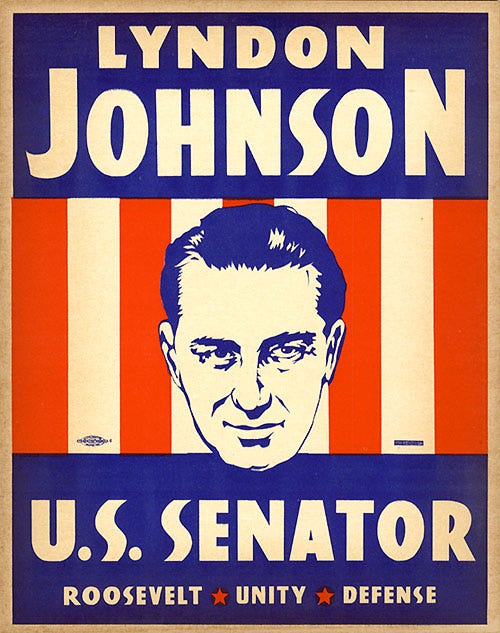
In Texas, there are unofficial vote counts and official vote counts. Each county would give their unofficial results right after the election and then over the next few days would certify the results and turn them into official counts.
Mechanically, the votes sat in physical ballot boxes under the control of local judges. During this election, LBJ was in the lead until some late-night phone calls were made and the judges started to change their votes to the exact amount needed to beat LBJ.
As Marsh’s American-Statesman was to comment bitterly, despite the fact that “These last votes were from the same county, the same folks” who had voted earlier, in this “late” vote “O’Daniel bettered his rate against Johnson, 16 times over.”
[A]t the time, Johnson’s lead was still more than 4,000 votes. Hour by hour — telephone call by telephone call — he had to watch it being sliced away: by seven p.m. Pappy [O’Daniel] was less than a thousand votes behind. … By the end of the [next] day, O’Daniel was more than a thousand votes ahead; the official final count would give him 175,590 votes to 174,279 for Johnson, a margin of 1,311.
The judges were literally bribed into changing thousands of votes and flipping the result from LBJ to Pappy O’Daniel. And the results held!
In fact, when LBJ heard about what was happening, his reaction wasn’t to protest. It was to call up judges in other counties and bribe them to change their votes for him! But most of the counties had already certified their results and LBJ couldn’t bribe enough officials of his own to switch the election back in his favor.
He did learn his lesson and in the 1948 Senate Race, he successfully flipped enough ballot boxes in his favor to secure his Senate seat.
Buying votes
In South Texas, there were large slums, filled with Mexican-Americans, who were controlled by “jefes” who told them who to vote for. In 1941, these jefes were paid by LBJ’s campaign to vote for LBJ.
The votes from the Valley came in. Duval County had given O’Daniel 95 percent of its vote just a year before; in that intervening year, O’Daniel’s popularity had evidently suffered a remarkably rapid decline; now Duval gave O’Daniel 5 percent of its vote — and gave Lyndon Johnson 95 percent. … In the five South Texas counties that voted as a bloc, in other words, Johnson received more than 90 percent of the vote: 3,491 to 376 for O’Daniel.
Notice how literally the year prior, O’Daniel had run for Governor and received 95% of the vote (because he paid the jefes for their votes). Now LBJ’s camp was willing to pay more than O’Daniel so the vote went 95% in the other direction. Entire counties were literally up for purchase! In the 1940s! In America!
Unfortunately, this wasn’t just in rural border towns. In San Antonio, LBJ helped Maury Maverick run his 1934 congressional campaign.
On the day before the election, Johnson was spotted in a hotel room with a giant pile of cash.
Johnson was sitting at a table in the center of the room — and on the table were stacks of five-dollar bills. “That big table was just covered with money — more money than I had ever seen,” Jones says. …. Mexican-American men would come into the room, one at a time. Each would tell Johnson a number — some, unable to speak English, would indicate the number by holding up fingers — and Johnson would count out that number of five-dollar bills, and hand them to him. “It was five dollars a vote,” Jones realized.
Our future president literally paid people for votes, $5 at a time!
Oh and this wasn’t just a Texas thing. It happened across the country.
In the big cities of the Northeast, votes might have cost more than five dollars each; in the slums of New York and Chicago, at least, it was not uncommon for Bowery and Skid Row residents to be handed tens or even, in a close election, twenties for their franchise.
Money in politics
People are very concerned about Super PACs in the wake of the 2010 Citizens United Supreme Court case.
Going back to LBJ’s 1941 Senate run, LBJ raised campaign funds from Brown & Root, a construction contractor who LBJ had secured millions of dollars of government contracts for as a congressman.
Representative Johnson had brought Brown & Root millions of dollars in profits. What might not Senator Johnson be able to do? On May 5, 1941, a luncheon was held in Houston at which were present thirty-four Brown & Root “subs,” the sub-contractors who had gotten a piece of the work on the Marshall Ford Dam or the Corpus Christi Naval Air Station. They were asked for pledges for the Johnson campaign. … Within the first few weeks of Johnson’s Senate run, Brown had put behind him well over $100,000.
For reference, the average campaign in Texas raised about $50,000 at the time. Brown & Root ended up giving him around $200,000 during this campaign and Johnson raised about half a million dollars in total.
It was the most expensive campaign ever run in Texas, all financed by oil companies and people looking for government contracts. (And LBJ still lost!)
Herman Brown ended up donating so much money to the campaign (and tried to get it written off as a tax write-off) that the IRS started to investigate them for exceeding campaign contribution limits and tax fraud. The local IRS branch investigated the case for 18 months and were going to recommend criminal charges against Herman Brown.
But since Herman Brown was such a big asset for LBJ and President FDR (who we will get to in a minute), FDR put a stop to the investigation.
But the opinion of the six agents who had been working on the Brown & Root investigation for eighteen months was not to carry much weight in its ultimate disposition. Johnson and Wirtz had seen Roosevelt on January 13. On that day, a new [IRS] agent, who had no previous knowledge of the case, was sent to Texas from the IRS bureau in Atlanta, Georgia, to make a “separate investigation” of it. Arriving in Texas on January 17, this new agent began studying the case. He proved to be a quick study indeed. Three days later, he told Werner, “The case as it now stands does not have quite enough evidence, in my opinion, for the Chief Counsel’s office to pass it for prosecution.
A few weeks later, the case was shut down, criminal charges dropped, and Brown & Root was ordered to pay back taxes plus a minor fine.
Crony capitalism
FDR was deciding whether to run for a third Presidential term and was going to have to fight against his Vice President, Garner.
Garner was extremely popular, especially in his home state of Texas. FDR needed money to beat Garner in Texas and LBJ offered to introduce him to Herman Brown, the same contractor we talked about before.
After Herman Brown visited the White House and met FDR, a massive government contract just happened to land in Brown’s lap.
The Corpus Christi Naval Air Station, “not emergent” in January, in February was moved abruptly, if quietly, onto the “preferred list” of Navy construction projects with the highest priority. The contract for the air base (which, it was now decided, would be of the “cost-plus” type so profitable to contractors) was not, it was also decided, to be put out for competitive bidding, but was to be awarded on a “negotiated basis.” And the only firm with which serious negotiations were held turned out to be Brown & Root; the firm’s lack of experience in the air base construction, which less than three months before had kept it from getting a contract for a similar base, was no longer mentioned.
The Corpus Christi project ended up being twice as large as any of the other 12 bases being built and was the only one in which funds were made immediately available. The contract went directly to Brown & Root (which netted them millions, an astronomical sum during the Depression) and in return, Brown & Root donated money to help FDR secure his nomination for President. Turns out LBJ wasn’t our only shady President at the time!
Non-citizen voting
Today, there are accusations that the left is trying to let immigrants across the border because they will vote democratic. It turns out that this actually happened regularly in the 1930s in Texas.
Nor were all voters even Mexican citizens; on Election Day the saloons of the Mexican town of Reynosa, across the Rio Grande from Hidalgo, were cleaned out, and truckloads of Mexicans were brought across to vote in Texas …. In Webb County, the small town of Dolores had about 100 American citizens — and in some elections recorded as many as 400 votes.
According to Caro, there was literally a systematic, documented effort to bring non-citizens across the border to vote in elections in the 1930s.
Extramarital affairs
Our last President was caught on camera bragging about being able to grab women wherever and whenever. Here is LBJ doing the same.
Displaying the same coarseness that, at college, had led him to exhibit his penis and call it “Jumbo,” he would show no reticence whatever about the most intimate details of extramarital relationships. His descriptions of his amours were not only exhibitionistic but boastful; particularly with cronies, he would seem almost to need to make other men acknowledge his sexual prowess. There was, seemingly, no aspect of an afternoon in bed — not even the most intimate details of a partner’s anatomy — that he did not consider grist for his vivid storytelling ability.
TL;DR
We should absolutely strive for better politicians and less corruption (and I am not condoning the behavior of our current politicians) but I must say, it was actually somewhat comforting seeing that the system was just as messed up before — probably even more so! — and that the country still survived.
Anyway, happy Election Season everyone. Hopefully this will be my last (and only) post on politics.
The other being Harry Truman.